Handheld Laser Marking Machine
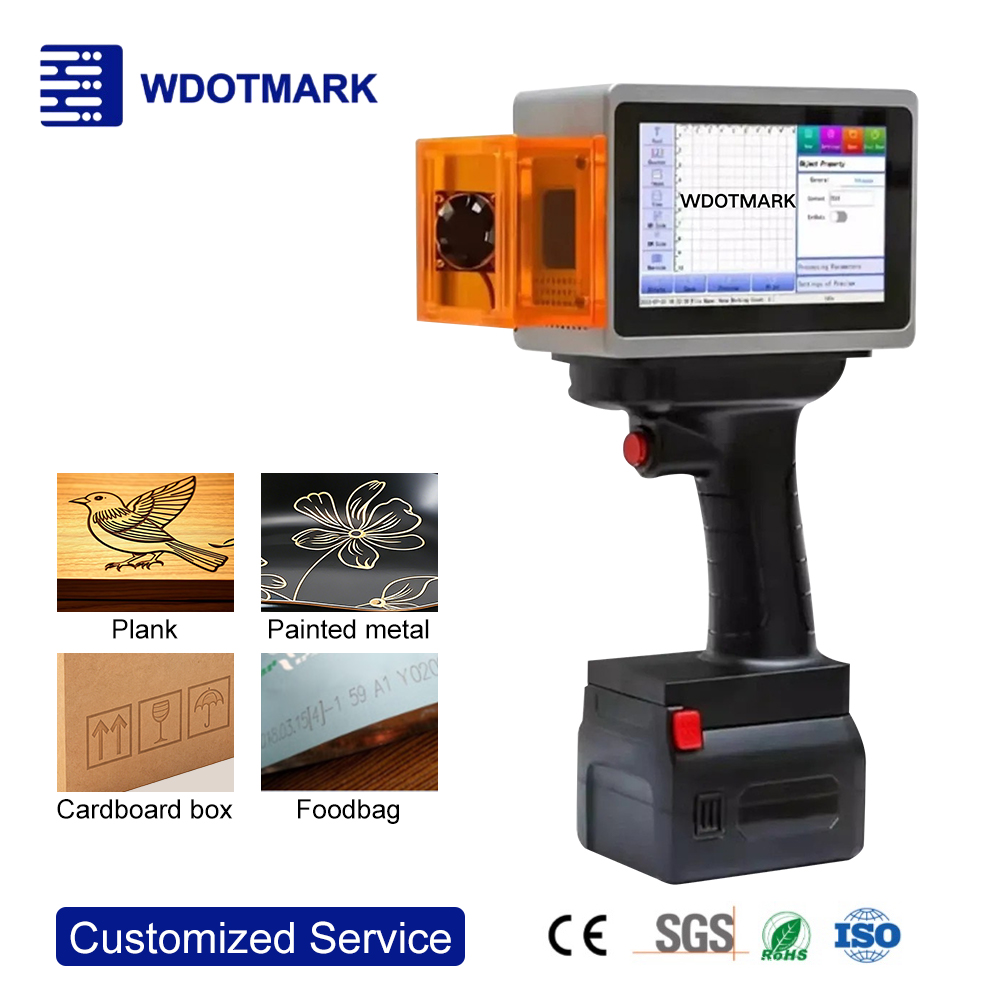
A handheld laser marking machine gives your team a fiber laser source without tying the work to a fixed bench. Instead of carrying a heavy steel plate, an assembled frame or a service part to a stationary machine, the operator brings the marking head to the workpiece. WDOTMARK supplies the handheld 20W fiber laser as part of a wider fiber laser line that also includes desktop and flying models, so buyers can match the format to the actual production layout rather than forcing one configuration onto every job.
This page covers the technical specifications of the handheld unit, the situations where it outperforms a fixed machine, and how it compares with desktop and inline fiber systems. All figures below come from the standard configuration we ship. If your material or cycle time sits outside these ranges, our engineering team can review the sample before you commit to an order.
Key Specifications
The handheld fiber laser is a plug-in unit built around a 1064nm fiber source. It is air cooled, so there is no water chiller to route or maintain on the shop floor. The standard configuration is 20W, with 30W and 50W options available depending on the marking depth and speed your application requires.
- Laser wavelength: 1064nm
- Power: 20W standard; 30W or 50W options available
- Marking speed: ≤7000mm/s
- Marking area: 100×100mm
- Cooling: air cooled
- Marking depth: up to 2mm
- Power consumption: 500W
- Power supply: 220V-50Hz or 110V-60Hz, single phase
- Control system: Linux
- Operation mode: plug-in (mains powered)
These specifications matter for procurement because they define what the unit can realistically handle in daily use. The 100×100mm marking area covers most nameplates, part numbers, serial codes, tool markings and traceability fields. The 2mm depth capability suits engraving on stainless steel, aluminum and copper where a surface-only mark would wear away. Because the machine runs on single-phase power at 500W, it can be used at a bench, in a service bay or beside a production line without an electrical upgrade.
For buyers who need to compare this unit against the wider range, the full fiber laser category is outlined at /fiber-laser-marking-machine/, which covers the T-F20–100 desktop series, the CCD vision T-F50 and the YT-F30 flying model.
Where a Handheld Fiber Laser Makes Sense
The case for a handheld fiber laser is usually physical: the workpiece is too large, too awkward or too expensive to move. A desktop machine assumes the part comes to the laser. A handheld unit reverses that assumption.
Typical situations include:
- Large or heavy workpieces. Fabricated frames, structural steel, pipe assemblies and machine beds that cannot be lifted onto a bench.
- Field service and repair. On-site marking of replacement parts, service tags or identification codes during maintenance visits.
- Marking beside the line. Applying codes to a part that is still mounted in a fixture, before it moves to the next station.
- Mixed-batch job shops. Where part sizes change constantly and a fixed working envelope would slow the operator down.
- Low-volume customization. One-off or small-batch marking without dedicating a full workstation.
The handheld fiber laser covers metals such as stainless steel, aluminum and copper, and also marks a range of non-metals including PP, PVC, HDPE, plastics, resin, cardboard, film, foil, rubber and wood. If your mix is mostly non-metallic — film, labels, paperboard or packaging substrates — a /co2-laser-marking-machine/ is usually the more appropriate source, since the CO2 wavelength interacts differently with organic materials.
Because the unit is air cooled and mains powered, it can be moved between departments, but it is not a battery-operated field tool. It needs access to single-phase power wherever it is used.
Handheld vs Desktop vs Flying
Choosing between formats is really a question about where the part is and how many of them there are. WDOTMARK builds all three fiber configurations, so the comparison below is based on the same laser technology in different mechanical arrangements.
Handheld (20W, 30W, 50W options). Maximum flexibility. The marking head reaches the part. Best for large workpieces, field service, fixture-mounted parts and job shops with unpredictable part geometry. Trade-off: the operator controls positioning manually, so throughput depends on handling time rather than machine speed.
Desktop (T-F20–100, 20W–100W). A fixed working envelope with repeatable positioning. Best for stable, repeatable marking of small to medium parts in batches — nameplates, fittings, tools, components. Higher effective throughput when parts can be loaded and unloaded consistently. Also available with CCD vision positioning in the T-F50 for automated alignment.
Flying (YT-F30, MIC 30W/50W/100W). Mounted over a conveyor for parts that keep moving. Best for inline production where stopping the line is not an option. This is the format for high-volume traceability coding rather than manual marking.
A practical rule: if the part can come to the machine and the volume is repeatable, choose desktop. If the part cannot move or the volume is low and varied, choose handheld. If the part never stops, choose flying. Many buyers operate more than one format, and the handheld unit often serves as the flexible backup for jobs the fixed machines cannot reach.
For buyers whose operations also require ink-based coding on packaging, our /cij-printer/ range covers continuous inkjet models for cartons, bottles and flexible film — a different marking method that complements rather than replaces laser.
Talk to an Engineer
Specifications on a page only go so far. The deciding factors are usually your material, the required mark depth, the available power supply and how the operator will physically reach the workpiece. Send us the part details and we will confirm whether the handheld fiber laser is the right fit — or point you to a desktop or flying model if it is not.
WDOTMARK (Guangzhou, China) is an SGS-audited supplier and an MIC Diamond Member. MOQ is from 1 unit, confirmed on inquiry, with lead times of up to 15 days. Certificates are available upon request. We have shipped to the Middle East.
Request a Free Marking Test — send your sample material details and required mark to sales@fiberlasermarker.com, or message us on WhatsApp at +86 193 0303 6632. You can also review our broader range at /laser-marking-systems/ or reach the team directly via /contact/.