CO2 Laser Marking Machine for High-Speed Non-Metal Lines
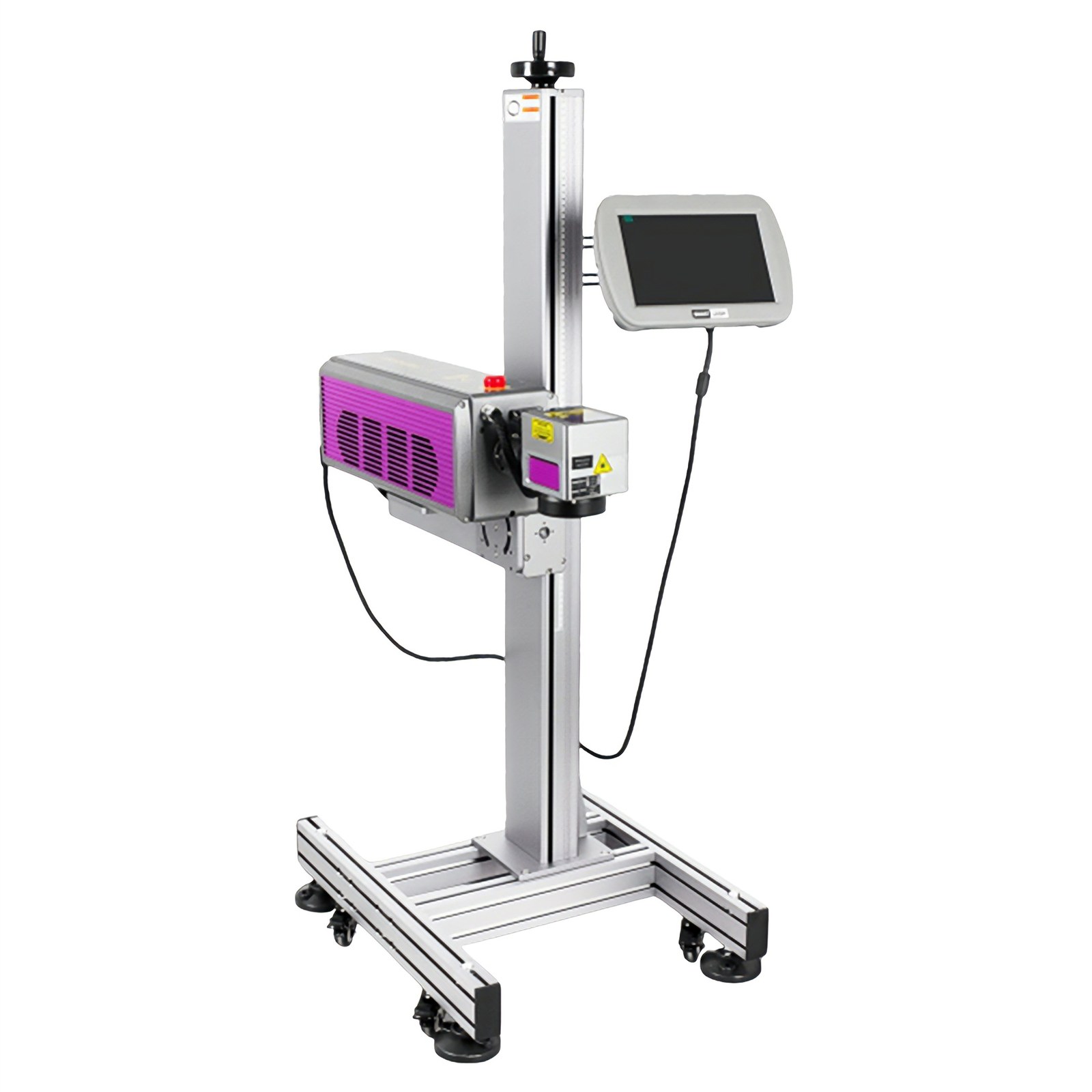
A co2 laser marking machine is the practical answer when your product is non-metallic and your line does not slow down for anyone. Cartons, films, plastic parts and packaged goods move past the head at production speed, and the mark still has to be legible, permanent and consistent. The WDOTMARK YT-C30 is a flying CO2 laser system built for exactly that job: a 10.6μm laser source, air cooling, a 10.2-inch touchscreen controller and line speeds up to 130m/min. If you are a distributor or an end user sourcing for packaging, converting or consumer goods production, this page covers the specification, the material fit and the setup choice between flying and static operation.
YT-C30 Flying CO2 Laser Marking Machine
The YT-C30 is the core configuration in the WDOTMARK CO2 range. It is a flying system, meaning it marks on the move rather than indexing each part under a stationary head. The specification below is the reference point for quoting and line integration.
- Laser type: CO2, wavelength 10.6μm
- Power options: 30W / 40W / 60W
- Marking speed: ≤12000mm/s
- Marking area: 110×110mm (optional sizes available)
- Minimum line width: 0.012mm
- Repeat precision: 0.003mm
- Production line speed: 0–130m/min
- Cooling: air cooled
- Control interface: 10.2-inch touchscreen
- Focus: dual red-light focusing
- Users: multi-user permission levels
Two details matter most to buyers. First, the 0.012mm minimum line width and 0.003mm repeat precision define how fine and how repeatable the mark can be, which decides whether small codes, batch data and thin character fonts are viable. Second, dual red-light focusing lets an operator align the head quickly during changeover, which shortens downtime on multi-product lines. Multi-user permission levels keep recipe and parameter access controlled across shifts.
Because it is air cooled, the YT-C30 does not require chilled water routing to the marking station. That simplifies installation on existing conveyors and reduces the utilities you need at the point of use.
Why CO2 for Non-Metals
CO2 lasers at 10.6μm are absorbed well by most non-metallic materials. That is why this wavelength dominates marking on paperboard, film, plastic and finished packaging, where a fiber source would reflect or work poorly. Typical applications include date and batch codes, lot numbers, barcodes and logos on cartons, flexible film, plastic containers, labels and general packaging surfaces.
The result is a mark created by the material itself rather than by ink. There is no consumable to refill, no ink smear on a fast film web and no solvent handling at the station. For lines already running at speed, that removes one of the most common causes of unplanned stops.
Material choice still needs testing, because plastic formulation changes how a mark appears. Some films mark with high contrast, others frost or change tone, and thin gauges need power tuned down to avoid cutting through. This is why we recommend sending your actual sample material for a test rather than relying on a generic material chart. Compare this with our /fiber-laser-marking-machine/ range if your parts are stainless steel, aluminium or copper, and with /uv-laser-marking-machine/ if you need a cold, low-contrast mark on plastic, glass or bottles.
Where the YT-C30 fits best
- Corrugated carton and case coding at high line speed
- Flexible film and laminate marking on converting or packaging lines
- Plastic containers, caps and closures
- General consumer packaging requiring batch and date data
Flying vs Static Setup
The single biggest selection question is whether the mark is applied on a moving product or a stationary one. Both are valid; they solve different production problems.
Flying (online) configuration
The YT-C30 is supplied as a flying system and the 0–130m/min line speed range reflects that. The head marks while the product passes, synchronised to your conveyor or web. Choose flying when:
- Products cannot be stopped without disrupting upstream or downstream equipment
- Throughput per hour is the primary cost driver
- The code is applied to packaging already formed and filled
- You want one station to serve a continuous stream rather than batch feeding
Static (offline) configuration
Static marking applies to parts presented one at a time or in trays, where speed is secondary to positional accuracy or where the surface needs a longer dwell. Choose static when:
- Parts are irregular and need fixturing under the head
- Production volume is low or batch-based
- The mark needs a larger area than a single pass at line speed allows
- There is no existing conveyor to integrate with
For integration work, WDOTMARK also supplies conveyors, pagers, feeding lines and vision inspection and rejection systems configured per project, so a flying head is not a standalone purchase if you need a complete station. Use our /laser-marking-systems/ overview if you are comparing laser, inkjet and thermal transfer approaches before committing to a technology. Distributors and integrators can also review the /applications/ pages for material and industry groupings.
Selection checklist before you request a quote
- Material and thickness of the substrate (send a physical sample)
- Required mark content: text height, lines, barcode or 2D code
- Line speed at the marking point, in m/min
- Available marking area on the product
- Power supply: confirm 220V-50Hz or 110V-60Hz single phase on site
- Whether the head must integrate with an existing PLC or conveyor
- Environmental conditions: dust, washdown, ambient temperature
Confirming these points before quotation avoids the most common integration rework: an undersized marking area, a head mounted where there is no room, or a power configuration that does not match the plant.
Talk to an Engineer
The fastest way to confirm whether the YT-C30 suits your material and line speed is a marking test on your own sample. Send us the substrate, tell us your line speed and required mark content, and our engineers will recommend the power option and configuration, including whether a flying or static setup is the right fit.
WDOTMARK is based in Guangzhou, China, holds MIC Diamond Member status and is SGS-audited. Certificates are available upon request. Lead time is up to 15 days, and MOQ starts from 1 unit, confirmed on inquiry. We have shipped to the Middle East.
Contact us at sales@fiberlasermarker.com or WhatsApp +86 193 0303 6632 to request a free marking test.