CIJ Printer for High-Speed Production Lines
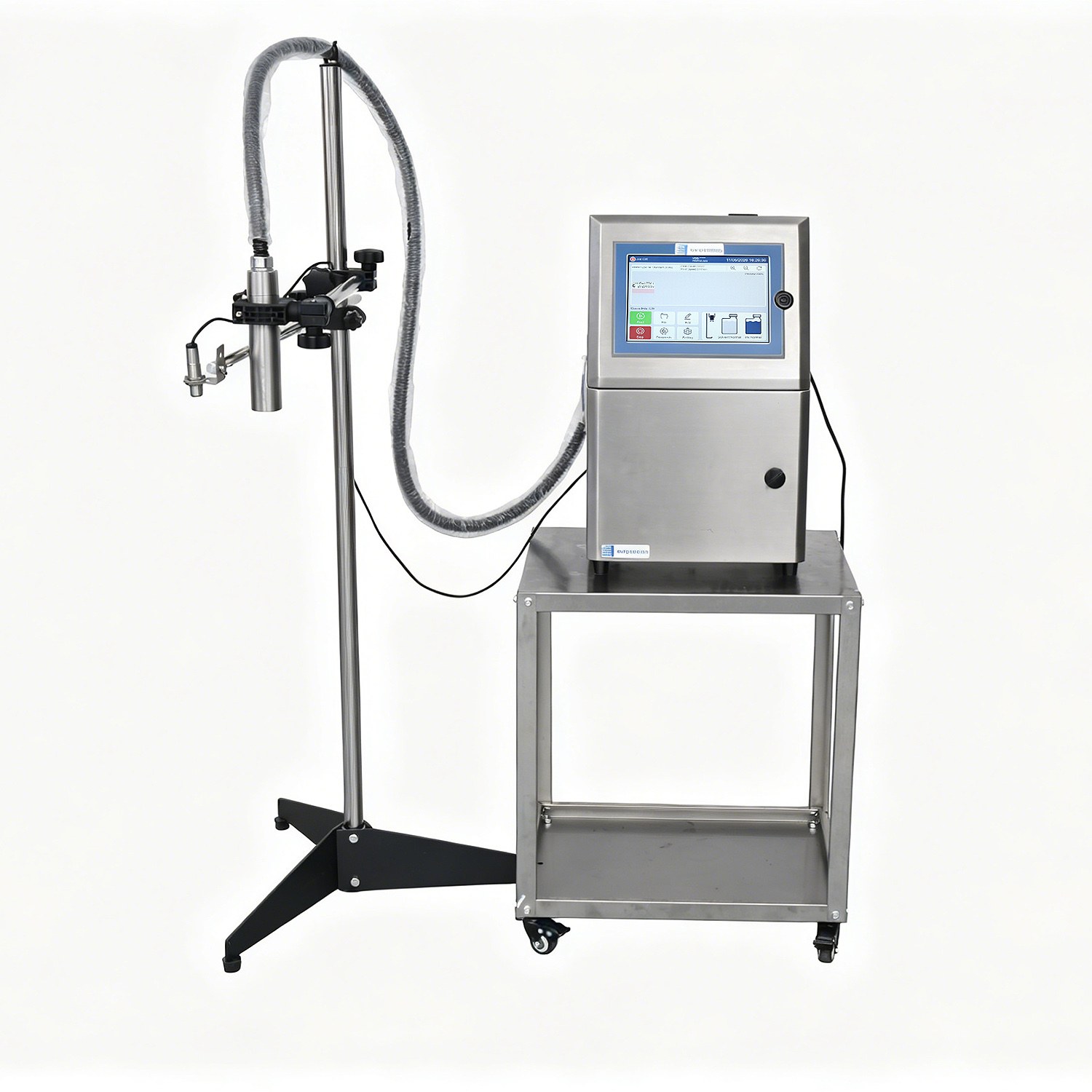
A CIJ printer is the workhorse of industrial date coding. WDOTMARK builds its own continuous inkjet lineup — the F640, F650, F660, F680 and ECJET1100 — for food, beverage, cosmetics and general packaging lines that need clean, legible codes at production speed. Whether you are coding batch numbers on bottles, expiry dates on bags or barcodes on cartons, the right CIJ printer keeps your line moving without stopping for maintenance every shift.
This page covers the WDOTMARK CIJ printer range, the materials and applications each model handles, and how to choose between continuous inkjet, thermal inkjet and laser marking. If you are a distributor or an end user sourcing for a specific line speed and substrate, the specifications below give you a starting point before you request a datasheet.
WDOTMARK CIJ Printer Lineup
The WDOTMARK continuous inkjet range is built around a single compact controller platform, with models scaled by print head configuration, nozzle size and ink system. All units share a 10-inch color touchscreen interface, so operators trained on one machine can run the entire series.
The F640 is the standard small-character CIJ model and the one most commonly specified for general packaging lines:
- 10-inch color touchscreen
- 60/70μm nozzle options
- 1–3 lines of print
- Print distance 5–40mm
- Dye-based ink
- 2700mm conduit length
The F650, F660 and F680 sit in the same series with different configurations, and the ECJET1100 covers buyers who need an alternative footprint or ink setup. We do not publish a full parameter table for these models here because configuration varies by ink type, line speed and substrate — contact us for datasheets and we will match the head and ink system to your application.
Common across the series:
- Small-character coding for high-speed lines
- Dye ink systems suitable for porous and non-porous surfaces
- Compact print head for tight installations on existing conveyors
- Compatible consumables available alongside the printer, including ink and solvent
For buyers already running inkjet equipment, our /ink-cartridges-consumables/ range covers fast-dry cartridges and compatible chips and solvents, so you can keep spare consumables on the shelf without a separate sourcing process.
Applications
Continuous inkjet printing is chosen when the code has to be applied directly onto the product or packaging at line speed, without a label and without contact. The ink jet breaks into charged droplets, deflects onto the substrate and dries in place — which is why CIJ remains the default for date and batch coding across fast-moving consumer goods.
Typical WDOTMARK CIJ printer applications:
- Food — expiry dates, production codes and lot numbers on bags, trays, films and cartons
- Beverage — date and batch coding on bottles, caps and secondary packaging
- Cosmetics and daily chemicals — batch numbers and shelf-life codes on bottles, tubes and boxes
- General packaging — cartons, bags, pouches and shrink wrap where a barcode, QR code or serial number is required
The combination of 1–3 print lines, 5–40mm print distance and a 2700mm conduit means the head can be mounted on a bracket above a conveyor while the controller sits in a cabinet or on a stand, keeping the print head where the product passes and the electronics away from washdown and dust.
If your line runs film, labels or pre-printed packaging where a thermal transfer overprinter is a better fit, we also supply /thermal-transfer-overprinter/ systems for those formats.
CIJ vs TIJ vs Laser
Choosing between coding technologies comes down to line speed, substrate and code permanence. Each has a clear zone where it wins.
- CIJ — best for high-speed lines and non-porous or irregular surfaces. The ink does not need contact with the product, so it handles curved bottles, textured bags and fast-moving conveyors without registration problems. This is the technology to specify when throughput matters most and the code must be applied directly to the pack.
- TIJ (thermal inkjet) — better for lower-speed lines, porous substrates and buyers who want cartridge-based consumables with minimal maintenance. See our /thermal-inkjet-printer/ range.
- Laser marking — permanent, no ink, no consumables, but limited to materials the laser can mark and typically slower on some substrates. Laser suits metal, some plastics and applications where the code must survive abrasion or chemical wash.
In practice, many plants run more than one technology across different lines. If you are comparing coding methods for a new line, start with the /laser-marking-systems/ overview to see where laser fits, then compare it against continuous inkjet for your substrate and speed.
For buyers who specifically need a continuous inkjet machine, our /continuous-inkjet-printer/ page covers the technology in more depth, and the /cij-printer/ range above shows the specific models available.
Request a Free Marking Test
The fastest way to confirm a CIJ printer will code your product cleanly at your line speed is to test it. Send us your substrate, your target code content and your line speed, and we will run a marking test and recommend the model, nozzle size and ink system that fits. MOQ starts from 1 unit, confirmed on inquiry, and lead time is up to 15 days.
Talk to an Engineer at sales@fiberlasermarker.com or WhatsApp +86 193 0303 6632 to request a free marking test or a datasheet for the F640, F650, F660, F680 or ECJET1100. WDOTMARK is based in Guangzhou, China, and ships to the Middle East.